the infamous index card recipe from gherringer's photostream.
to be totally candid, i couldn't wait for wednesday morning to roll around so that i could begin posting this guest series from a group of kids who recently took a field trip to the 826chi center with a theme of "recipes and reflections." when i approached 826 about raising money for them when i guest bartend next week, i had no idea there was a food theme in their program. here's the prompt they offer for teachers on the theme:
Everyone loves food, but what does it really mean? During this field trip, students bring a family recipe and discover how food holds more meaning than just the ingredients in the recipe. Students work with volunteers to write reflections, incorporating memories of the recipe and its place in their lives. At the end, volunteers type the stories and the class is mailed a class book with their class photo on the back.
so much of what i've found through this blog is rooted in the premise of this simple exercise. there are endless stories to tell surrounding our food—which is why i can't get my fingers to type fast enough to introduce to a new way of storytelling on this blog. writing on "hawaiian pork chops," and the first in what will be a series of posts from the 826 kids, here's dylan's reflection on his family's recipe...
"Hawaiian Pork Chops"
By Dylan C.
The recipe for Hawaiian pork chops runs in my family. They taste really good and also they are easy to make. We make them for holidays or just days that we just like to have good food. It tells people that I really like yummy food. Also every time I hear “Hawaiian pork chops” my mouth waters, especially when my dad makes them. Some ingredients are brown sugar, ketchup, salt, pepper, and plenty more. The holiday we usually make it on is the Fourth of July. When I hear the word I get really hungry. When we make them everyone can help themselves—or at least if you hurry up.
this isn't my drink, but it'll look something like it,
ward eight via cookthinker's photostream.
a week from tonight, for two hours, i'll be wearing my bartender pants. thing of it is, i've never worn those pants before. i don't even know what they look like. so one can only hope pants like those have pockets full of whiskey, right?
i'm guest bartending. i've been fortunate to cross paths with sarah stegner at prairie fire here in chicago, who is both co-chef and owner of the restaurant. every tuesday night the restaurant hosts a guest bartender, inviting them to serve a cocktail of their own recipe, with any tips raised going to a charity of that person's choosing. when sarah asked me a while back if i'd come in and do this, i didn't really hesitate to say yes.
i'll be pouring out a ward eight, which is a classic whiskey drink with somewhat of a story. the drink is named for a boston politician appointed to state government in 1898, and it was the voting margin in boston's ward eight that helped push him over the top. and the restaurant that created the drink? locke-ober. a place that is alive and kicking pretty strong near beacon hill still today—and brings the story full circle, with our short-lived boston roots. but i'm calling mine a ward826.
most major cities in the u.s. have an 826. l.a. has one, and so does boston. and there was one down the street from alicia and i in chicago last year, and we didn't even realize it—which made us feel pretty small, with our mfa-creative-writing-gung-ho-literary-student-loan-debt-enthusiasm and all. that's because 826 is a non-profit writing and tutoring center, for children.
"the facade of 826chi. the boring store is a front for the spy store is a front
for the after-school writing program," via rcavalcante's photostream.
the 826 centers are a product of writer dave eggers, whom a lot of people know from his book a heartbreaking work of staggering genius. when i was writing more, his mcsweeney's collection of stories and essays was the one publication i wanted to see my work published in. the writing is off-the-grain, unique, and the kind of stuff we'd all be better off with stumbling across just a bit more.
a student reads in november via 826 chicago's photostream.
so even though i've worked closely with taste of the nation and am more recently working with green city market and the upcoming family farmed expo, there wasn't much hesitation when i decided to go to 826chi with my tips for next tuesday night. and they reciprocated. so much so that they've shared a few samples of student writings from a recent "recipes and reflections" field trip to the center. the kids bring a family recipe with them on the trip, and the point is to discover how food holds more meaning than just the ingredients in the recipe. if you've read this blog before, that should sound just a tad familiar, no?
everything looks better upside down, via 826 chicago's photostream.
so for the rest of the week leading up to my stint behind the bar at prairie fire, i'll be featuring an entry a day from the kids.
and in the meantime, if you're in chicago, make plans for next tuesday night. i start pouring my ward826 (whiskey, oj, lemon, and grenadine i'm making myself) at 6pm and won't stop until 8pm. and the kicker? the auer family foundation has stepped up as a matching donor for the night—so whatever tips are raised, we're now throwing the kids twice as much.
The third post in a series of guest posts from the team at RIA and Balsan in the Elysian Hotel, Brian O'Connor gets down to the anatomy—sometimes hair pulling—of sourcing product, and specifically seafood, that's sustainably harvested. This blog exists because I wanted to know the stories behind where my food was coming from—and this post hits on that note, to the T. For more on Monday's dinner, go here.
Yesterday I mentioned the challenge of a longer supply chain. At the restaurant we try to know everyone from whom we purchase product. We visit our local farms and hang out with the farmers at the market. Our Sommelier, Dan, gets regular visits from winemakers and makes his own way out to their properties as much as possible. While we’ve had a few chances to drop in on oyster farms in the northwest and we can work out a trip on a fishing boat now and then, it’s difficult in the middle of the country to build the kind of direct relationships we’re used to with the multitude of mariners who regularly catch our fish.
So what can we do to make up for it? “We have to know, and trust, our purveyors,” says our Chef de Cuisine Danny Grant. He singles out a handful: Pierless Fish, Ingrid Bengis Seafood, and especially Mika Higurashi at SONA (which stands for Sustainability of Natures and Aquaculture). “I know I can tell Mika what I am looking for and she will find the highest quality and the best source.” It’s a lesson learned over and over in this business: personal relationships are the path to success.
So now that we’re more comfortable outsourcing our direct purchasing to a trusted wholesaler, what do we buy? Let’s walk through a dish we’ll be serving Monday night: Sea Scallop, Caviar, Octopus, Fumet Blanc.
A RIA dish: Scallop and Octopus. With
turnip, sturgeon caviar, fumet.
The above is a chilled appetizer of gently poached scallop and octopus with hakurei turnip, American sturgeon caviar and a classic fumet emulsified with a touch of crème fraîche. It features a variety of seafood, each of which can be sustainably sourced.
Ingrid’s Diver-Harvested Scallops
Sea Scallops are a success story for sustainable seafood. In the 1970s industrial scallop capture nearly destroyed the natural population of Atlantic scallops. By the 80s the US began to restructure its scallop fisheries, introducing catch limits and rotational fishing and even closing off entire areas to harvest. The tenacious scallops showed their resilience and populations rebounded faster than anyone imagined.
Scallops have little inherent vulnerability. They are small, mature quickly and reproduce in large numbers (females produce 15-60 million eggs). Additionally, biomass has been closely watched since the 80s and populations are known to be large and strong. While East Coast US fishing regimes are not always thoroughly enforced, the fisheries have been managed reasonably well.
However, there remain concerns about by-catch and habitat damage due to the trawling used to capture the majority of commercial scallops. These trawls scrape along the ocean bottom, regularly upsetting the balance of the ecosystem and also capturing skate, flounder, sea turtles and other marine life.
Thankfully, a responsible alternative exists: scallops hand-harvested by divers. This less-invasive method avoids much of the ecosystem damage and by-catch while also functioning on a day-to-day basis. Instead of large ships dredging up scallops and then holding them aboard for a week or two before returning to land, the “diver” scallops are harvested in the morning and brought ashore in the afternoon. By the next day we have them in the kitchen.
When they come ashore, Ingrid Bengis-Palei or one of her employees is waiting for them. Ingrid Bengis Seafood was a pioneer in the Northeast quality and sustainability revolution of the 80s and 90s (she’s been called the Alice Waters of seafood for her role). She knows most of the Mainers who gather seafood in the icy waters around Deer Isle and she works with them to find the best of the best. As so often happens, the individual touch so important to sustainability also brings us product of the highest quality.
Wild Spanish Pot-Caught Octopus
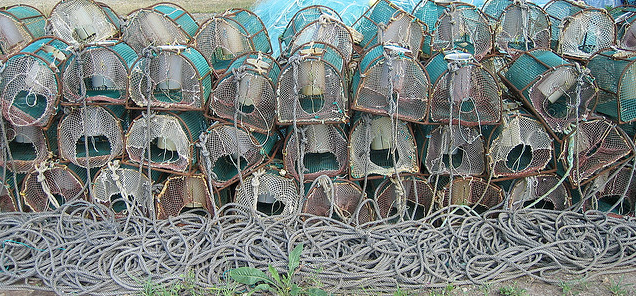
Like lobster pots in New England, these pots help Spanish fisherman
effectively catch wild octopus, via catrien's photostream.
Researching Octopus is a great way to dive into the complexities of sustainability. A variety of octopus fisheries exist worldwide, each of them managed differently. A quick glance at the Monterey Bay Aquarium’s seafood card finds international wild octopus listed as “avoid.” Uh oh. However, the Aquarium publishes more detailed Seafood Reports that approach the issue with an academic level of detail and flesh out more specifics for each fishery. The major reason octopus gets a red “avoid” is because it is nearly impossible, sitting at a sushi counter or browsing in a grocery store, to reliably tell the provenance of the product. With a bit of research, though, one can find sources of responsibly caught octopus.
Our relationships help us find these sources. We get our wild octopus from Spain, where fisherman head out daily to pull in their pot traps. The octopus has a relatively short lifecycle and produces hundreds of eggs, which means it has little inherent vulnerability. Overfishing does not occur and the inland pots catch mostly mature octopus with negligible by-catch. The true size of the stock is unknown, but fishing levels have remained constant for nearly 30 years in a well-watched regime. The remaining environmental concerns revolve around uncertainty: little is know about the octopus’s role in the larger food chain.
Additionally, Spanish fisheries have been remarkably creative in responding to the ecological and economic challenges of modern fishing. Spanish institutes often develop and fund those Sardine-counting studies I mentioned yesterday and the Spanish have been at the forefront of modernizing aquaculture to restore marine environments (more on that in my final post).
Petrossian American Sturgeon Caviar
Petrossian is a caviar staple, and a staple in our kitchen, too.
Unlike the scallop, the wild sturgeon is not a success story. Sturgeon are long-lived fish and they tend to reproduce rarely. They are inherently vulnerable to overfishing.
Worldwide stocks remain at levels so dangerously low that many governments have outlawed their capture. Black market fishing continues, often catching the fish only to open them and remove the gleaming black caviar inside. As stocks near extinction (and the remaining fish tend to be chock full of PCBs and Mercury), the US has banned the import of Caspian Sea sturgeon caviar.
In the US wild sturgeon are making a comeback and there is even one viable (and heavily regulated) commercial fishery in the Columbia River. The meat of these fish is delicious. For caviar, however, we turn to aquaculture—fish farming.
After years of research and failed experiments, in the 1980s scientists in California finally succeeded in raising sturgeon in captivity. Since then, commercial sturgeon aquaculture has taken off and currently exists in three states with plans to expand to others. As these operations improve, caviar packers have begun to partner with them to cure, pack and age the sturgeon roe in the quest to create a product comparable to the legendary Caspian caviar.
Petrossian has been selling caviar since the 1920’s, when they worked with Cesar Ritz to establish caviar as a symbol of luxury. While there is a certain status conveyed by the tiny eggs, we like them because they are delicious—well cared for, aged and packed.
Petrossian sources their sturgeon roe from Stolt Sea Farms in Sacremento, California. As might be imagined, aquaculture avoids the sustainability concerns of wild seafood such as population vulnerabilities and overfishing. By-catch isn’t really a problem when one is raising only fish for harvest.
There are, however, other environmental concerns associated with aquaculture (more on this in the next installment!) and Stolt does a fine job addressing them. The sturgeon are raised in water that is re-circulated, avoiding the escape of farmed fish or waste into natural ecosystems. The waste is processed and sold as fertilizer. The one remaining challenge in current sturgeon aquaculture is that the fish are carnivorous and eat more seafood than they produce.
One Dish, 1200 Words
The heartbeat of the kitchen...
OK—I hope the anatomy of a single dish’s sourcing helps to illuminate some of the thought that goes into selecting our seafood. Are we perfectly sustainable? Of course not. Are there trade-offs and compromises involved in our decisions and sourcing? Certainly. But by utilizing the resources we have and cultivating relationships with like-minded people, we can take great steps toward operating a more responsible restaurant.
One of the most common refrains in discussions of sustainable seafood is that transparency is key. We need transparency from the folks catching the fish about their methods and the status of their fisheries. We need transparency from our purveyors regarding the provenance of the product. And we need to remember that our guests need transparency in order to make well-informed decisions. We don’t list every single purveyor on our menu, but we do our very best to ensure our team knows the source of every single item on the plate.
By the way, the hakurei turnips come from Heritage Prairie Farm in La Fox, Illinois.
This post is the second in what has now evolved to be four guest entries from my friends in the kitchen at the Elysian Hotel—and today we're hearing from Executive Chef Jason McLeod. On Monday night they're hosting a 'ocean-friendly' seafood dinner at RIA, in partnership with the Shedd Aquarium's Right Bite program. The dinner is $150 per person, so this is quite the bounty for whoever wins... but for me, I'm helping spread word of an issue I care deeply about.
Common in South America, this little guy will be spreading the
ocean-friendly message Monday at RIA, via Oleg Volkov's photostream.
It's official. Not only will we be cooking with some gorgeous sustainable seafood Monday night, but we just found out we'll have some very special friends visiting us throughout the dinner, too. Some, how do I say this, unique friends... and I think it's safe to say it'll be the first time either will have set foot in the Elysian. Actually, I doubt they get out much in Chicago at all.
Roll out the red carpet, people—we'll be joined by a Red Foot Tortoise and a Blue Tongue Skink. And I know, those names are great, aren't they?
I don't know about you guys, but this takes me way back to my childhood. We were lucky enough to have a zoo that made trips to our school with all sorts of cool stuff from the zoo and that day was always one of the best of the year. I mean, getting up close to animals and reptiles and birds I'd never seen before and skipping out on class? That's the real deal, man.
Needless to say, this news had the staff giddy with excitement—which got us thinking. We need to have some more fun with this. To spread the message to more people. So, because we're now on twitter and constantly plugged in to that always spinning network, we're gonna open up two seats to the Shedd Dinner via a little contest... and whoever comes out on top? Those seats are theirs, on us.
The Blue Tongue Skink will be there Monday night, too. Common
in the Land Down Under, we'll have one in the dinning room.
via floridanaturephotography's photostream.
And here's how it's gonna work...
Part 1. Correctly answer the following two questions in the comment section of this blog post (correct answers will be published on the blog upon receipt):
1) Our ocean-friendly dinner menu will be featuring sea scallops. This tasty seafood is considered what species?
(*UPDATE* No need to go crazy specific here, just tell us if it's a bird or reptile or... you know.)
2) The ocean-friendly dinner menu will also include Dungeness crab. This crab is named after a region found where?
3) What luxurious seafood was once considered to be 'poverty food,' fed to prisoners and servants? Some servants even demanded contracts that they could be fed this food no more them three times per week.
Part 2. Post the following on twitter, tagging @riabalsanchefs in the post (tweets submitted before correct completion of Part 1 will not be accepted, first person to finish is dining with a plus one on us):
1) A photograph of any RIA dish featuring any of the above three types of seafood.
Follow the rules and finish first and you'll be hanging out with a Red Foot Tortoise and a Blue Tongue Skink, too—though, maybe don't dress like them?
And keep a look out for Brian's second post, following the first he posted the other day. He's been working his tail off on this project—and that's not easy when you have a restaurant to run!
On Monday, November 15, Ria restaurant, one of my newest partners, will team up with the Shedd Aquarium to present an “Ocean Friendly” dinner featuring a sustainably-sourced menu. For the next three days, Ria General Manager Brian O’Connor will discuss the complexities and concerns associated with sourcing sustainable seafood, a struggle difficult for restaurants, but one I hope more and more take on—and one I've written about at length in the past.
Hi there. Thanks to Johnny Auer for providing this opportunity to think out loud (or in type) about some of the challenges and rewards involved with sustainable seafood. I’ll be posting three times on the subject: today I’ll discuss the general goals and criteria of sustainable sourcing, tomorrow I’ll get into some examples we face each day in the restaurant, and then Friday I’ll do my best to describe the future direction I see the whole endeavor heading.
Sourcing sustainable seafood presents even more complex challenges than those associated with other sustainable food. The usual concerns associated with sustainable sourcing are there: environmental impact, methods of production, and of course quality of the product. Additionally, we have to worry about the uncertainty inherent in a longer supply chain, the stability of species populations and the length of their reproductive lifecycle, and even the effectiveness of public and private oversight.
Investigating the sustainability of our seafood presents other problems. We make it a point to regularly visit and communicate with our farmers, and we can see firsthand the methods used and even debate their effectiveness when necessary. Getting out to the Alaskan seas three times a year, however, is prohibitively expensive. If we were able, we’d still have a hard time tracking the vulnerability of population stock or seeing if the rest of the fleet fishing the species were as responsible as the boat we were on. The issue is vast as—well—the ocean.
Thankfully, we have the work of the Monterey Bay and John G. Shedd Aquariums to guide us. Through their Seafood Watch and Right Bite programs, they collect and distribute a wealth of information regarding wild and farmed seafood. Monterey Bay has even established a set of guiding principles and criteria for objectively judging sustainability. These criteria group fish into three categories: Best Choices (Green), Good Alternative (Yellow) and Avoid (Red). These evaluations are invaluable to the chef or restaurateur interested in sourcing sustainable seafood.
There are five Seafood Watch criteria for evaluating the sustainability of wild-caught seafood. They focus on the stability of the species itself, the effects of capture on the surrounding environment and the effectiveness of enforcing any necessary limits on catch. Here they are:
•Inherent vulnerability to fishing pressure
The more resilient a species, the less likely it is to be overfished. For this criterion we consider the growth rate of the fish, its fecundity (a great term for reproductive capacity), and its maximum age.
Compare a sardine and a coastal shark. Sardines begin reproducing as young as two years old and live 5-10 years. Additionally, they produce loads of offspring. Sharks mature in 8-15 years (longer for females), can live 30+ years and produce only a handful of young. The shark is inherently vulnerable to overfishing because it cannot reproduce as quickly as it can be caught.
This criterion evaluates how “endangered” a species is. We consider the overall biomass of the species and the rate at which it is captured. This is surprisingly difficult to assess accurately. (Imagine trying to count all the sardines in the Mediterranean: How do you find them all? How do you ensure you don’t count a sardine twice? These are just the initial challenges.)
Because of the difficulty accurately assessing wild stocks, the Seafood Watch program adopts a conservative position: uncertainty is assumed unsustainable. If we cannot be sure the health of a stock, it is considered unhealthy. As we will see in the coming days, this leads to some of the most interesting questions in the evolution of the program.
•Nature and extent of discarded by-catch
As anyone who has been fishing can attest, one can never be sure what is on the end of the line until it is reeled in. As the scale of fishing increases from basic hook-and-line to longlines with hundreds of hooks to football-field-sized trawls dragged along the ocean floor, it becomes more difficult to catch only the intended fish. Methods which reduce or eliminate by-catch are more sustainable.
We often look for hook-and-line caught fish as it not only limits by-catch (which is quickly thrown back), but also because the smaller scale tends to lead to better quality product. Each fish pulled aboard is cared for properly: the body is not packed awkwardly, bending and denaturing the flesh; it is processed as necessary and sent to us as quickly as possible; also, it provides a more direct link between the source of the product and the final dish. In addition to hook-and-line, diver-harvested and trapped seafood also tend to limit by-catch.
•Effect of fishing practices on habitats and ecosystems
This criterion directly addresses the double-whammy of massive trawling operations. As the anchors holding down the trawl net scrape along the ocean floor, entire ecosystems are disturbed and even destroyed. The smaller-scale the operation and the less invasive the method, the smaller the footprint left behind.
Additionally, this section looks at the role the fish itself plays in the larger ecosystem. Removing a creature that is a vital link in the food chain can have lasting consequences far beyond immediate physical damage.
What you might find when eating at Ria...
•Effectiveness of the management regime
For the final standard we take a step back and investigate exactly how all of the above criteria are managed and enforced. Many fisheries limit yields or methods of capture, but if there is no enforcement mechanism these limits are routinely ignored. Additionally, the disincentives must be strong enough to stop the offending behavior but not so strong they discourage good fishing practices.
Again, uncertainty is treated as unsustainable. Without a certifiable metric for measuring effectiveness, management regimes are assumed to be “good alternatives” at best. To address this challenge, a number of different operations have emerged, from completely government-controlled and operated to those formed by industry association and privately overseen. In time, we will be able to better assess how each of these designs works and hopefully take the best of each to move forward.
So that’s a (somewhat) brief introduction to how we think about sustainable seafood. The Seafood Watch guiding principles and criteria give us a great starting point to examine the product we are using in the kitchen. Sometimes small changes can make huge improvements in practice: switching from Atlantic to Pacific Halibut or dropping Monkfish off a menu immediately make it more sustainable.
The real challenge is in the gray areas. Should I use wild diver-caught scallops? If I know the person fishing my black bass and I am certain she fishes it sustainably, am I right to use it? These are the real questions we face each day in the restaurant and these are the questions I’ll address tomorrow.
the whisnant's of rain crow ranch, an all grass-fed and pasture raised cattle farm.
i think a lot of us enjoy retaining information. it's why the history channel and the travel channel and animal planet and every other odd and random niche of a network are on our tv listings, right? and now, we have social media. we have things called news feeds on facebook and streams on twitter. every minute of every day these feeds are updated with pictures and links and snippets of stories being told by someone, somewhere that we're not at that exact moment. while there are definite downfalls to this, there's also a tremendous upside. i'm retaining more random news and info than i ever have before!
which is why i was so excited to find a whole foods post in my news feed announcing a nation wide sale on grass-fed ground beef at every single one of their stores this coming friday, september 3. grass-fed ground beef. $3.99 per pound. just in time for labor day. are you kidding me?
cheeseburger time via whole foods.
but i was also skeptical. how in the world can whole foods pulls this off? how can the farmers afford it? and whose beef is this? who are those farmers? well, luckily, whole foods wasn't shy to share just exactly where the beef would be coming from for every single store in their repertoire. so i now know that the beef i'm buying this friday is coming from a 10,000 black angus cattle farm in missouri called rain crow ranch. it's a family farm run by a husband and wife (she has a doctorate and her husband studied in both agriculture and marketing) and their six kids. that's the kind of story i want to hear—and the kind of producer i want to buy from. read the list of farmers to find out where whole foods will be getting your beef from.
people have issues with whole foods ranging from things like cost to political opinions to issues with a lack of local product in their stores, i understand this. but if you're going to cook out this weekend, and you're buying ground beef anyway, then why in the world would you not take whole foods up on this?
and why grass-fed beef? hear it from the doctor (and mom) of the whisnant family:
"grassfed products have enormous health benefits. higher in omega-3 fatty acids, higher in cla, higher in vitamin e, higher in beta-carotene, lower in calories grass fed beef is one of the healthiest protein sources on the planet. though these health benefits can be measured by science they alone do not represent the true product. grass fed is as much a process as it is a product. it is a sustainable management philosophy that benefits not only the product but also the animal, the producer and the environment. grass fed beef as a product is the tip of an underlying mountain of strength and integrity rooted in family farms that put their hearts and hands into what they produce. each farm has its own unique story and history; i would like to share part of ours with you."
for more on rain crow ranch, and to really understand what goes into an operation like this—why it's important for the cattle to be fed on grass and raised in fully sustainable and organic pastures—i implore you to watch this video. this is the kind of food education we all should've gotten when in school, as kids. the kind of education our own kids are still not getting. and it's right here at your fingertips! and there's no processing or butchering at all, it's clean!
before the housing boom, the san fernando valley was, unlike it is today, fairly desolate—its acreage filled from foothill to foothill with farmland, the plots of which were on the whole dotted with orange trees. but then the california aqueduct was built and los angeles had its water. thus, the migration beyond the basin began, and development exploded in the valley beyond.
i grew up in one of these homes, at the very edge of the western rim of the san fernando valley. so too did my mother, only in the northern tip of the valley, which was one of the first neighborhoods to be built amongst the farmland. my grandparents own this house still, and even now, my grandfather harvests oranges from the three trees that remain on their property. and as i wrote in the first post of this blog, the memory of the orange tree that hung over the backyard of my childhood home lingers with me still.
and that, for me, is the human element behind this necessity of life, such a widely marketed and ballyhooed thing, this thing called food.





 Posts
Posts