
Showing posts with label cargill. Show all posts

Thursday, December 10, 2009

beef recall? here we go again


i talked yesterday about mainstream media and it's inability to divulge the entire picture when it comes to our foods, and the incredible strain the industry's practices place not only on our health, but the global environment. well, here's an example of a deterrent. i have to thank an independent media source based out of madison, wisconsin for this video—she's provided the start to several stories i've covered—kathleen slattery-moschkau, host of the kathleen show.

but picking up on this, buried in the headlines just a few days ago was the story of a beef recall on the west coast. the company, beef packers inc., recalled 22,723 pounds of beef. this after two cases of salmonella poisoning in arizona and new mexico were traced back to the fresno processing plant. what's sad is that 23,000 pounds of beef may sound like a lot, but it's just a fraction of the output these guys pump through their systems everyday.

now what if i told you this same meat packer recalled 800,000 pounds of beef just four months ago, again amid fears of salmonella poisoning? well, that's exactly what happened.

the worst part about this is beef packers inc. is only the beginning. remember that story i wrote a couple months back? about a packing giant in the midwest called cargill? i was inspired by the nytimes article chronicling a healthy, twenty-something new york girl who's now paralyzed after eating cargill's beef at a family gathering, remember? cargill. cargill. cargill. can't forget a name like that, right? well, beef packers inc. is a subsidiary to cargill, the parent company to a sputtering empire of half-assed meat processors, catered to feeding the masses an embarrassing quality of beef product at jacked prices.
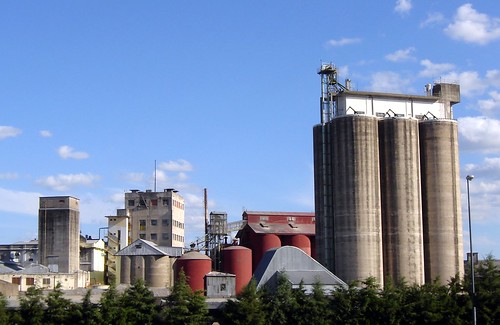

(photo via fedepo18 of cargill's rosario, argentina plant)


(via the progressive magazine of government closure
of their brazilian soy plant, amid criminal destruction
of rainforest, sold to european markets as chicken feed)

why is this not a major issue in washington? why does the media just glaze over what's slowly and gradually becoming more and more apparent about our foodstuff? that these two most recent cases of salmonella poisoning happened in arizona and new mexico, hundreds and hundreds of miles from fresno, a small city in northern california, a state larger than most of the world's countries, is wrong, is it not? how is that not self-evident? and who knows how far that beef traveled, and through how many other plants, before it made its way to fresno. remember, in that october story some of cargill's beef was coming from as far away as south america.

so slowly but surely, the truth is finding its way to the surface. but even in the cnn clip above, in no way does the interviewer press the representative from the national pork producer's council when she blatantly exposes, though unknowingly, how pathetic the inspection methods are when animals go to slaughter. a usda inspector is on the line, that's mandatory she says, her intent to strengthen the case of regulatory practices for the conglomerate pork industry, but then she says the inspector gives "basically a quick physical exam. is the pig healthy, is it not, in [the inspector's] professional judgment."

look. there it is right there. when you go to the doctor for a physical exam, would a quick up and down inspection make you feel at home with the doctor's diagnosis? so then why in the world would you eat something that goes through this very thing before it's slaughtered, processed, packaged, and shipped to your local supermarket and applebee's?

and what does this say about the usda's authority? its ability to be a force in the face of the lobbyists of these giant corporations?

i hate to draw the comparison, but how disturbing was the inspection scene in schindler's list when the men were forced to de-robe, then inspected in this very same manner by nazi physicians, which essentially decided whether or not they'd die immediately or be forced into labor until they were rendered physically unable to work any longer, and thus killed anyway. is there any difference at all?

i'm asking for someone to argue against me, because i really want to know how in the world we've allowed something like this to happen in our country. who said this was okay? and who the heck decided we were better off left in the dark?

cargill. cargill. cargill.

(and for more on healthy living, check out this awesome idea.)

Tuesday, October 6, 2009

mystery meat: meet the hamburger

anybody who knows me, knows my love of the hamburger. it's something of a tradition now that anyone who meets my family for the first time is told the story of my first words, peeped from the backseat of the car while zooming past the golden arches of mcdonald's, "shakes and fries, shakes and fries!"

in my senior year of high school, when my day ended at 12:30 and i was let out to the world, where i'd find an empty home and a freezer full of the frozen burger patties my brother brought home from the meat market he worked at, i ritually fired up the barbecue and grilled myself a cheeseburger for lunch. day in. day out.

needless to say, i've come a long way, but my affliction for the ground beef patty has yet to vanquish. which is why alicia's heightened fear of my favorite food is so jarring.


the thing has spread fast, but still, like all corporation controlled markets of our food systems, the news of the october 3 ny times piece by michael moss hasn't rattled our country's infrastructure nearly as much as it should have.

in that story, michael draws attention to stephanie smith, a twenty-two year old woman who is paralyzed from the waist down, not from a car accident or birth defect or even physical injury, but from eating a hamburger.

the graphic above is linked to the ny times website, so if it's too small to read on my site, jump over to their's to check this whole thing out.

but don't you see, it's simple to think when you come home with ground beef from the market that the beef is simply what it says to be: beef. and yes, it is. but as the graphic details, the beef that composes the mass produced hamburger patties of wisconsin based cargill, just one example of the behemoth producers of our favorite grocery and fast-food grilling item, there's far more to this foodstuff than the simple grounding of a single cut of beef from a single cow.

because there is no single cow, nor single cut.

in fact, there's no way to know how many cows went into the e coli tainted, undercooked burger that stephanie smith ate at a family dinner two years ago at all. the process of cultivation for that burger is so complex, so deviated from the simple cultivation of small farms that sell directly to the consumer, not even the usda nor cargill's lawyers have traced a source of contamination of the beef strong enough to hold up in court.

for cargill's patties, the meat was sourced from as far away as uruguay and labeled from each source as things like, "fresh fat," "frozen lean," and "lean finely textured beef." cargill uses each different source to compose its patties, which shaves a hefty chunk of cost from its overhead in comparison to keeping everything in-house. and the danger, as moss notes, is that these sources are selling cargill scraps of beef that are mixed from various cows, which increases the risk of contamination, especially considering that some of the scraps are as cheap as they are because they come from parts of the cow that are more prone to come in contact with the cow's fecal matter.

so one would then think that these slaughterhouses and producers, like greater omaha packing in nebraska, which slaughters 2,600 cattle a day "in a plant the size of four football fields," would keep a tight watch for e coli with conastant testing and analysis, right? if i told you moss reports most of these guys test a sample only four times a year, would that make any sense to you? yeah, it sure as hell doesn't to me either. do you have any idea how much meat is produced from a plant that pumps out 2,600 cattle carcasses a day? think about that.

and consider this, pulled directly from the article:

"the food safety officer at american foodservice, which grinds 365 million pounds of hamburger a year, said it stopped testing trimmings a decade ago because of resistance from slaughterhouses. 'they would not sell to us,' said timothy p. biela, the officer. 'if i test and it’s positive, i put them in a regulatory situation. one, i have to tell the government, and two, the government will trace it back to them. so we don’t do that.'"

so here's a producer like cargill, who outsources their trimmings, who at one point seemingly did the right thing. they went above and beyond the regulatory guidelines of the usda, a government branch whose sole existence is to better monitor and control the food systems and cultivations of our country, but stopped because doing the right thing was simply, bad business. verbatim, we have a food safety officer at one of country's largest producers telling us that they're not going to test because if they do, they'll get the positive-test inducing slaughterhouse in trouble with the government. am i missing something here? am i just so dense and stupid that this makes no sense at all to me?

better yet, here's a quote of the article where moss draws from the usda itself:

"dr. kenneth petersen, an assistant administrator with the department’s food safety and inspection service, said that the department could mandate testing, but that it needed to consider the impact on companies as well as consumers. 'i have to look at the entire industry, not just what is best for public health,' dr. petersen said."

again, am i missing something? i understand the massive ramifications of government sanctions in a capitalistic economy, but this is a doctor declaring that public health is essentially not a strong enough factor to mandate necessary and life-saving reform. a doctor employed by the government. what in the world is going on here?

tomorrow is wednesday, and in los angeles there's a small group of people who will celebrate the day, as they do every week, as cheeseburger wednesday. a day, literally, more holy than even the highest of holy days of christianity and judaism. and if i were still there, i'd join them, as evidenced by this picture that was tagged of me on the internet, in which i blatantly appear.

there's a trust that currently exists between consumers and producers, including restaurants. when i go to in-n-out and order my double-double, i'm confident the two small patties on my burger are fresh and honest and made from high-quality, safely processed cows, right? think of all the burgers you've eaten in your lifetime. the same should be said for every single one of those greasy sandwiches, right? but a) i don't think that trust exists any longer (it hasn't for me for a while now) and b) that trust existed solely because we as consumers were never presented with the facts. in fact, those facts—industry practices and procedures that make the burgers we eat—aren't known because they're secrets—guarded secrets.

hence, exhibit a:

"the meat industry treats much of its practices and the ingredients in ground beef as trade secrets. while the department of agriculture has inspectors posted in plants and has access to production records, it also guards those secrets. federal records released by the department through the freedom of information act blacked out details of cargill’s grinding operation that could be learned only through copies of the documents obtained from other sources. those documents illustrate the restrained approach to enforcement by a department whose missions include ensuring meat safety and promoting agriculture markets."

to be honest, i intended this post to be light and quick and a highlight of moss' article, something that was interesting and disturbing that didn't require a lot of work, nor writing, on my part. obviously, that wasn't the end result.

what do you think? am i taking it too far, expanding too much energy on posts like this? is it verbal diarrhea? or is this worth the time. are you actually reading, and feeling at least a slight impact, by a post that runs on as long as this one has?

alicia wants me to stop eating burgers altogether. i assure you, that isn't happening. but knowing that very few restaurants—though more and more have begun to—are sourcing humanely raised, organic, local and small farm butchered beef, it's going to take a lot of convincing before i jump back on the burger bandwagon and order the things from greasy corner joints like i used to.

i work for a chef who has convinced me. several days a week i walk into the prep kitchen and see a cook pushing beef through a grinder, before it's hand packed into patties, which makes me feel damn good about where i work. and as for buying ground beef from the market, for a while now i've only bought organic ground beef, almost always from whole foods, which for now, is a market i hold that aforementioned trust with that i talked about above.

in the meantime, here's an upper for this downer of a raincloud on the beacon that is the burger:

my grilled peach and red onion bbq cheeseburgers.
Related Posts with Thumbnails